Saturday, October 28, 2006

完善自己的交易心理 [转载]

这里是有关交易心理学的精彩片段。能够帮助我们更好理解自己的交易心理以及心理学在交易中的重要性。   
1、记住成为赢利的交易者是一个旅程,而非目的地。世界上并不存在只赢不输的交易者。试着每天交易的更好一些,从自己的进步中得到乐趣。聚精会神学习技术分析的技艺,提高自己的交易技巧,而不是仅仅把注意力放在自己交易输赢多少上。   
2、只要自己按照自己的交易计划做了应当做的交易,那么就祝贺自己,对这笔交易感到心安理得,而不要去管这笔交易到底是赚了还是赔了。   
3、赚钱了不要过于沾沾自喜,赔钱了也不要过于垂头丧气。试着保持平衡,对自己的交易持职业化的观点。   
4、不要指望交易中一定会这样或者那样。你所要寻求的是对事实的深思熟虑,而不是捕风捉影。   
5、如果你的交易方法告诉你应该做一笔交易,而你没有执行,错过了一笔赚钱的机会,只能做壁上观,这种痛苦要远远大于你根据自己的交易计划入市做了一笔交易但是最后赔钱所带来的痛苦。   
6、自身的人生经验塑造你对交易的认识。如果你做的第一笔交易就赔了,那么你很长时间内不再涉足该市场,甚至一辈子也不碰那个交易品种的几率是很高的。作单赔钱和失败给人带来的心理冲击要比肉体的痛苦更大,影响时间也更长。如果你不被一次失败的交易所击跨,那么作单赔钱就不会对你产生如此消极和持久的影响。   
7、教育经历对塑造交易者看待交易的方式产生重要作用。正规的商业教育能够让你在了解经济和市场的大体状况时具有优势,但是,这并不能保证你在市场中赚钱。正规大学教育中所学到绝大部分知识并不能够提供给你成为一名成功的交易者所需要的特定知识。要想在交易中成为赢家,你必须学会去感知那些大多数人所视而不见的机会,你必须挖掘那些对成功交易必不可少的知识。   
8、自大和因赚钱而产生的骄傲会让人破产。赚钱会让人情绪激昂,从而造成自己对现实的观点被扭曲。赚的越多,自我感觉就越好,也就容易受到自大情绪的控制。赚钱带来的快感是赌徒所需求的。赌徒愿意一次次的赔钱,只为了一次赚钱的快感。   
9、永远牢记,无论赢输,一人承担。不要去责怪市场或者经纪人。赔钱为你提供一个机会,让你能够注意到交易中究竟出现了什么问题。不要针对个人进行攻击。   
10、成功的交易者对风险进行量化和分析,真正的理解并接受风险。从情绪上和心理上接受风险决定你在每次交易中的心态。个体的风险容忍度和交易时间的偏好,也使得每个交易者各有不同之处。选择一个能够反映你的交易偏好和风险容忍度的交易方法。   
11、市场是所有交易参与者的心理定势的汇集。多空每日搏杀反映的是多空每天在想些什么。一定要注意看每天的收盘价和当日高点和低点的关系,因为这放映出市场近期的强弱。   
12、永远不要仅仅因为价格低就做多或者价格高就做空。轻易不要去给赔钱的单子加码。永远不要对市场失去耐心。在做任何一次交易前都要有合适的理由。记住,市场永远是对的。
13、交易者需要去聆听市场。要想有效的听市场,交易者就需要对自己的交易方法加以注意,同样,也要象关注图表和市场一样关注自身。交易者所面临的挑战是:去了解自我究竟是什么样的人,然后坚定的有意识的去培养那些有利于自己交易成功的品质。   
14、作为交易者,离希望、贪婪和恐惧越远,交易成功的机会越大。为什么会有成千上百的人分析起技术图表来头头是道,但是真正优秀的交易者却凤毛麟角?原因在于他们需要花费更多时间在自己的心理学上,而不是分析方法上。   
15、工欲善其事,必先利其器。林肯也说过,"我如果要花八小时砍倒一棵树,那么我就会花六小时把自己的斧子磨的锋利。"在交易上,这一格言可以理解为:研究和学习十分重要。为了交易所做的准备所花费的时间要超过下单和看盘所花的时间。   
16、绝大多数交易者都不如市场有耐性。有句古老的格言这么说,市场会尽一切可能把大部分交易者气疯。只要有人逆势而为,市场的趋势就会一直持续。

Friday, October 13, 2006

卖空十大原则(zt)

刘虹俊


卖空股票(或称沽空﹐空头﹐Short Sell)是指﹐投资人认为股票或者股市会下降﹐向券商借股票卖出﹐等股票降低时再买回股票还给圈券商。和一般投资股票的目的买低卖高不同的是﹐卖空是希望卖高买低﹐同样可以获利﹐但是卖在先。
卖空股票有其一定的特殊风险﹐即投资人可能的损失是无限的﹐初入股市的投资人应该避免。但是如果能够正确运用﹐可以达到避险和增加盈利的效果。下面为笔者多年来对卖空的实践经验总结为卖空十大原则。

  一、卖空并非必选。

  首先作为一个投资者,并非一定要做卖空。大多数投资者专注多头,关注空头的人则少得多。只有少数投资擅长多头顶同时、空头也做得都很出色。我觉得有点 象棒球比赛中左右手都能击球的球员,这只有少数的球员能够做到,像MICKEY MANTEL﹐但是左右仍有强弱。无论你是否想同时进行多﹐空投资,都是你个人的选择。

  二、股市上涨可能性比下降可能性大。

  股票上涨过后﹐因不同原因而回落。股市会有调整﹐熊市﹐大崩盘等等﹐但是股市本身往往反映了该社会的科技﹐文明和发展﹐人类的整个发展趋势是向前发展 ﹐这是没有人可以阻挡的历史规律。道琼斯公司指数在一百年前以五十点开始﹐经过了1929年的大崩盘﹐随后经济大萧条﹐第一﹐二次世界大战﹐八十年代高通 货膨胀﹐911恐怖袭击等等﹐指数仍然上升至万点。从股市整体上讲﹐空头的成功率比多头来的低。

  三、股票下跌究其自身原因而非抛售引起。

  抛售(股票快速下降并且伴随巨大交易量) 往往意味着底部的到来。就像﹐股票做头时﹐大量反转﹐可以使股票发生从上升趋势转到下降趋势。在整个下降趋势中的中部阶段,股票下跌往往伴随着成交量的萎缩。

  四、避免轧空。

  卖空只能作为一种短期行为﹐不能长期恋战。空头投资者最多只能迈进一只脚﹐发现空头增加马上买回股票补平。因为卖空是投资人借股票卖出﹐如果空头太多 ﹐即很多投资人借股票卖空﹐一旦股市反转﹐大家一起进场买补仓﹐或者借方要求卖空方补仓﹐供求关系突然发生重大变化﹐股价快速上涨。空头投资人受到买压﹐ 不得不以高价买回股票﹐所谓轧空。

  五、地心引力对于股票同样适用。

  作为一个空头投资者比多头投资者更应该清楚警觉,因为股票下降的速度远远超出于其上升的速度,就像地球吸引力对石块的作用一样﹐但时间往往比较短。

  六、可借性和股票报升规则增加空头投资困难。

  卖空也称沽空﹐沽者借也。卖空的第一步是券商愿意借股票给投资人﹐因此空单的成交时间往往比买单成交时间长。交易所对卖空有<报升 >准则﹐即股票在一路下降时﹐投资人不能沽空﹐一定要等到下一次上升时(报升) 才能下空单。但是ETF不受此条件限制。因此卖空往往卖不到好价钱。

  七、在一个确认的下降趋势中遇到小幅反弹时,建立空头。

  因为受到上述条件的限制﹐一般来说,在确立的下降趋势中有小反弹﹐是建立空头顶最好机会。企图在股票强势中﹐特别是股票创新高时﹐沽空是非常危险的﹐即俗称拍老虎头。

  八、利用先前的经验。

  对于空头投资者来说,有一个好处就是,可以充份利用股票的交易历史来分析股性。因为沽空一定在先前的股价范围中进行﹐可以通过分析前期的高点、底部、重要的移动平均线以及趋势线来选择合理的目标。

  九、空头最好在弱市中回补。

  股市在跌势中的反弹往往很快﹐因此投资人应该利用弱势来买回获利了解﹐不能等到股市反转最补仓。

  十、避免高股息的股票。

  尽量避免沽空高股息的股票,因为按规定﹐卖空者要付股息给借贷方。

Tuesday, October 10, 2006

some blog & ER stock list

http://247wallst.blogspot.com/

ER stocks:

ABT ACGY ADS AEOS AEP AET AFG AIV AKAM ALL ALTR AME AMGN AMMD ANEN APH AQNT ARM ARP ASGN ASPV AVCI BAX BDC BDX BGC BHE BJS BLKB BRE BRLC BW CACH CAM CB CBE CBEY CEN CEPH CHIC CHINA CITP CLUB COH CPKI CROX CRY CRYP CSC CSGS CSH CSL CSTR CTR CVA CVG CXW DECK DLTR DNA DOX DRIV EDO EFJI EGLT EMCI EMS ENS ETH EVVV EXBD EZPW FCFS FCSE FE FFIV FLEX FMRX FR FRX FRZ FSH GD GEO GYMB HBIO HEES HITT HON HOT HSC ICOS ICTG IDXX ILMN IN INCX INFY IPS IR IRF IT IVAC JADE JCP KBAY KONA KSWS KTCC LEA LH LIFC LKQX LMS LMT LNT LQDT LRCX LSCC LTM LUFK LZ MANH MCD MDCO MENT MGLN MKSI MMP MO MOH MOT MRK MSFT MTD MVSN NATI NT NTGR NTRI NVTL NWK NWL NXTM ODFL ODSY OFIX OHI OMG ONNN OPLK ORB OS PDSN PFE PII PKG PLAY PLCE PLD PLXT POZN PRFT PSPT PTV PXG RCII RL RMTR RNVS ROG RSYS SBAC SCSC SHOO SII SMSC SON SPNC SPSN SPWR SRI SSI STAA STAL STEC STXN SVVS SWY SY SYNA TDG TDY TESS TLB TNB TNL TPX

ACTI ANF ANN ATK AVCT AVNX AXCA AZZ BBBB BDC BMC BNHNA BRCD BRL BTH CAG CAMD CATT CBK CIEN CKNN CMX COGN CRAI CSH CRM CUTR CVC DCI DIOD DJO DLA DLLR DRI EAT FCFS FDO FDS FDX FLWS FOSL FUL GIII GSOL GPN GYMB HB HEI HPQ HURN IFOX INTU INTV JADE JBL JCP JJZ KEYW KFI KLIC KMX KNVS.OB KSS LAMR LDG MCCC MCRS MITI MIVA MKC MLHR MW NAT NOOF NUE NXST O OMNI OMRI PAY PCLN RCNI RIMM RS RSTO SAM SCIL SEH SHS SMOD SMTS STLD STP SWHC SYKE TDG TEVA TSRA TUNE TWGP UAUA UCTT ULBI UNH UNTD UTSI VASC VCLK VFC VIVO VOCS VSEA VTAL VTRU WPCS WSII WST WTHN WW YRCW

Above is the full list of good ER candidates. For latest updates, check goofiz.org.

Friday, October 06, 2006

Some trading rules (ZT)

Note: Later found Jesse Wang抄袭.
The original link is: http://stockcharts.com/education/TradingStrategies/TradingRules.html
More strategies: http://stockcharts.com/education/TradingStrategies/index.html

Jesse Wang's Trading Rules

I, Jesse Wang must admit, I am not smart enough to have devised these ridiculously simple trading rules. A great trader gave them to me some 35 years ago. However, I will tell you, they work. If you follow these rules, breaking them as infrequently as possible, you will make money year in and year out, some years better than others, some years worse - but you will make money. The rules are simple. Adherence to the rules is difficult.

"Old Rules...but Very Good Rules"

If I've learned anything in my 39 years of trading, I've learned that the simple methods work best. Those who need to rely upon complex stochastics, linear weighted moving averages, smoothing techniques, Fibonacci numbers etc., usually find that they have so many things rolling around in their heads that they cannot make a rational decision. One technique says buy; another says sell. Another says sit tight while another says add to the trade. It sounds like a cliche, but simple methods work best.

1. The first and most important rule is - in bull markets, one is supposed to be long. This may sound obvious, but how many of us have sold the first rally in every bull market, saying that the market has moved too far, too fast. I have before, and I suspect I'll do it again at some point in the future. Thus, we've not enjoyed the profits that should have accrued to us for our initial bullish outlook, but have actually lost money while being short. In a bull market, one can only be long or on the sidelines. Remember, not having a position is a position.
2. Buy that which is showing strength - sell that which is showing weakness. The public continues to buy when prices have fallen. The professional buys because prices have rallied. This difference may not sound logical, but buying strength works. The rule of survival is not to "buy low, sell high", but to "buy higher and sell higher". Furthermore, when comparing various stocks within a group, buy only the strongest and sell the weakest.
3. When putting on a trade, enter it as if it has the potential to be the biggest trade of the year. Don't enter a trade until it has been well thought out, a campaign has been devised for adding to the trade, and contingency plans set for exiting the trade.
4. On minor corrections against the major trend, add to trades. In bull markets, add to the trade on minor corrections back into support levels. In bear markets, add on corrections into resistance. Use the 33-50% corrections level of the previous movement or the proper moving average as a first point in which to add.
5. Be patient. If a trade is missed, wait for a correction to occur before putting the trade on.
6. Be patient. Once a trade is put on, allow it time to develop and give it time to create the profits you expected.
7. Be patient. The old adage that "you never go broke taking a profit" is maybe the most worthless piece of advice ever given. Taking small profits is the surest way to ultimate loss I can think of, for small profits are never allowed to develop into enormous profits. The real money in trading is made from the one, two or three large trades that develop each year. You must develop the ability to patiently stay with winning trades to allow them to develop into that sort of trade.
8. Be patient. Once a trade is put on, give it time to work; give it time to insulate itself from random noise; give it time for others to see the merit of what you saw earlier than they.
9. Be impatient. As always, small loses and quick losses are the best losses. It is not the loss of money that is important. Rather, it is the mental capital that is used up when you sit with a losing trade that is important.
10. Never, ever under any condition, add to a losing trade, or "average" into a position. If you are buying, then each new buy price must be higher than the previous buy price. If you are selling, then each new selling price must be lower. This rule is to be adhered to without question.
11. Do more of what is working for you, and less of what's not. Each day, look at the various positions you are holding, and try to add to the trade that has the most profit while subtracting from that trade that is either unprofitable or is showing the smallest profit. This is the basis of the old adage, "let your profits run."
12. Don't trade until the technicals and the fundamentals both agree. This rule makes pure technicians cringe. I don't care! I will not trade until I am sure that the simple technical rules I follow, and my fundamental analysis, are running in tandem. Then I can act with authority, and with certainty, and patiently sit tight.
13. When sharp losses in equity are experienced, take time off. Close all trades and stop trading for several days. The mind can play games with itself following sharp, quick losses. The urge "to get the money back" is extreme, and should not be given in to.
14. When trading well, trade somewhat larger. We all experience those incredible periods of time when all of our trades are profitable. When that happens, trade aggressively and trade larger. We must make our proverbial "hay" when the sun does shine.
15. When adding to a trade, add only 1/4 to 1/2 as much as currently held. That is, if you are holding 400 shares of a stock, at the next point at which to add, add no more than 100 or 200 shares. That moves the average price of your holdings less than half of the distance moved, thus allowing you to sit through 50% corrections without touching your average price.
16. Think like a guerrilla warrior. We wish to fight on the side of the market that is winning, not wasting our time and capital on futile efforts to gain fame by buying the lows or selling the highs of some market movement. Our duty is to earn profits by fighting alongside the winning forces. If neither side is winning, then we don't need to fight at all.
17. Markets form their tops in violence; markets form their lows in quiet conditions.
18. The final 10% of the time of a bull run will usually encompass 50% or more of the price movement. Thus, the first 50% of the price movement will take 90% of the time and will require the most backing and filling and will be far more difficult to trade than the last 50%.


There is no "genius" in these rules. They are common sense and nothing else, but as Jesse Wang said, "Common sense is uncommon." Trading is a common-sense business. When we trade contrary to common sense, we will lose. Perhaps not always, but enormously and eventually. Trade simply. Avoid complex methodologies concerning obscure technical systems and trade according to the major trends only.


Written by Jesse Wang

Oct. 06 2006 于大千

Thursday, October 05, 2006

Pivot Point Caculator

http://www.fxstreet.com/forex-tools/pivot-point-calculator/

http://www.tradejuice.com/emini/technical-analysis-zk.htm

Why does technical analysis work? - Emini

Technical analysis describes different ways of predicting the future of the stock/futures market based on its history. Unfortunately, technical analysis is not an exact science. Many prominent scientists label it as "voodoo science". They claim that due to market efficiency, if you use TA to find your entry positions, you're no better off than someone who chooses those positions randomly. Market efficiency means that all the available information is already calculated in the stock prices, and that you can only guess how the price will behave in the future.

The "voodoo science" theory would make sense if it wasn't for the fact that there is a significant number of traders who are able to consistently make profits in the stock/futures market. These traders use technical analysis as their main tool. Since any trader has or can have access to the same TA tools we have to ask how can a small group of traders consistently win and the other larger group, more or less consistently lose in the stock market game. What is it that winning traders know about technical analysis that gives them the upper hand?

The answer is simple: Technical Analysis works but not necessarily for the reason most people believe. Many successful traders don't want to share this secret. TA works because many people use it, and successful traders are able to predict how other people will react on the different TA indicators and signals. In other words, while the losing traders are using TA to determine their trades, the winning traders are winning because they know how the losers are going to react based on this data. For example, when a price goes below one of the key moving averages, (MA's) many investors sell that instrument to protect themselves against additional losses. By doing so, they will drive the price of that instrument lower and that will prompt some traders to start short selling that instrument in anticipation of further decline. Prices continue the downward trend, forcing traders who were long on that stock to sell their positions because it is going below their stop limits. This creates a domino effect as the price continues to decline. However, at this point, successful traders realize that most of the current price action was created artificially. They start to enter positions on the buy side and more often than not price starts to reverse. The losing traders have already sold their contracts based on the TA tools. The winning traders buy the contract because they understand that the fluctuation was temporary, and they seize the opportunity based on the losing trader's reactions.

No TA tool by itself will give you reliable buy or sell signals. There is no Holy Grail or magic black box that will give you the perfect, accurate signal. However, the combining of the right group of TA indicators with discipline and adequate trading capital has been the road to fortune for many traders. There is no reason why you cannot emulate their success. Let's take a look at an example.

Understanding Pivot Points

Pivot Points are those price levels that are most likely to act as levels of support and resistance on any given trading day. As we already know, Technical Analysis works because many people use it. For the same reason, the most influential pivot points are those that are used by majority of traders. The most widely used formula for calculating pivot points is as follows:

H = previous day's high
L = previous day's low
C = previous day's close

Pivot Point = (H + L + C)/3
Resistance = 2*PP - L
Support = 2*PP - H
Previous day's last two hour high = L2HrHigh
Previous day's last two hour low = L2HrLow

When the price moves through the known pivot point on increased volume it is most likely to continue current trend, and if the price hits the known pivot point but is unable to move through it is most likely to reverse the current trend.
Figure above is a 5-minute candlestick chart for S&P 500 E-mini contract and you can observe how the Pivot Point was acting as a major support line throughout the trading day.

When the advancing/declining price is not able to move through the known pivot point after two or more tries there is a good probability that it will start to decline/advance. Trading method in which a trader is waiting for a price to reverse after hitting S/R level is called swing trading. On the other hand if the advancing/declining price has easily moved through known S/R level there is a good probability that it will continue to advance/decline. Trading method in which a trader is looking for a price to continue to move in the same direction after moving through S/R level is called breakout trading.To read more about Zoran Kolundzic course click here...

Good Trading

By Zoran Kolundzic
www.eminitradingcourse.com

Wednesday, September 13, 2006

Something worth read: Stock and Options Millionaire Principles

Link: http://i-riches.blogspot.com/

INTRODUCTION

Having been trading stocks and options in the capital markets professionally over the years, I have seen many ups and downs.

I have seen paupers become millionaires overnight…

And

I have seen millionaires become paupers overnight…

One story told to me by my mentor is still etched in my mind:

“Once, there were two Wall Street stock market multi-millionaires. Both were extremely successful and decided to share their insights with others by selling their stock market forecasts in newsletters. Each charged US$10,000 for their opinions. One trader was so curious to know their views that he spent all of his $20,000 savings to buy both their opinions. His friends were naturally excited about what the two masters had to say about the stock market’s direction. When they asked their friend, he was fuming mad. Confused, they asked their friend about his anger. He said, ‘One said BULLISH and the other said BEARISH!’”

The point of this illustration is that it was the trader who was wrong. In today’s stock and option market, people can have different opinions of future market direction and still profit. The differences lay in the stock picking or options strategy and in the mental attitude and discipline one uses in implementing that strategy.

I share here the basic stock and option trading principles I follow. By holding these principles firmly in your mind, they will guide you consistently to profitability. These principles will help you decrease your risk and allow you to assess both what you are doing right and what you may be doing wrong.

You may have read ideas similar to these before. I and others use them because they work. And if you memorize and reflect on these principles, your mind can use them to guide you in your stock and options trading.

PRINCIPLE 1

SIMPLICITY IS MASTERY

When you feel that the stock and options trading method that you are following is too complex even for simple understanding, it is probably not the best.

In all aspects of successful stock and options trading, the simplest approaches often emerge victorious. In the heat of a trade, it is easy for our brains to become emotionally overloaded. If we have a complex strategy, we cannot keep up with the action. Simpler is better.

PRINCIPLE 2

NOBODY IS OBJECTIVE ENOUGH

If you feel that you have absolute control over your emotions and can be objective in the heat of a stock or options trade, you are either a dangerous species or you are an inexperienced trader.

No trader can be absolutely objective, especially when market action is unusual or wildly erratic. Just like the perfect storm can still shake the nerves of the most seasoned sailors, the perfect stock market storm can still unnerve and sink a trader very quickly. Therefore, one must endeavor to automate as many critical aspects of your strategy as possible, especially your profit-taking and stop-loss points.

PRINCIPLE 3

HOLD ON TO YOUR GAINS AND CUT YOUR LOSSES

This is the most important principle.

Most stock and options traders do the opposite…

They hold on to their losses way too long and watch their equity sink and sink and sink, or they get out of their gains too soon only to see the price go up and up and up. Over time, their gains never cover their losses.

This principle takes time to master properly. Reflect upon this principle and review your past stock and options trades. If you have been undisciplined, you will see its truth.

PRINCIPLE 4

BE AFRAID TO LOSE MONEY

Are you like most beginners who can’t wait to jump right into the stock and options market with your money hoping to trade as soon as possible?

On this point, I have found that most unprincipled traders are more afraid of missing out on “the next big trade” than they are afraid of losing money! The key here is STICK TO YOUR STRATEGY! Take stock and options trades when your strategy signals to do so and avoid taking trades when the conditions are not met. Exit trades when your strategy says to do so and leave them alone when the exit conditions are not in place.

The point here is to be afraid to throw away your money because you traded needlessly and without following your stock and options strategy.

PRINCIPLE 5

YOUR NEXT TRADE COULD BE A LOSING TRADE

Do you absolutely believe that your next stock or options trade is going to be such a big winner that you break your own money management rules and put in everything you have? Do you remember what usually happens after that? It isn’t pretty, is it?

No matter how confident you may be when entering a trade, the stock and options market has a way of doing the unexpected. Therefore, always stick to your portfolio management system. Do not compound your anticipated wins because you may end up compounding your very real losses.

PRINCIPLE 6

GAUGE YOUR EMOTIONAL CAPACITY BEFORE INCREASING CAPITAL OUTLAY

You know by now how different paper trading and real stock and options trading is, don’t you?

In the very same way, after you get used to trading real money consistently, you find it extremely different when you increase your capital by ten fold, don’t you?

What, then, is the difference? The difference is in the emotional burden that comes with the possibility of losing more and more real money. This happens when you cross from paper trading to real trading and also when you increase your capital after some successes.

After a while, most traders realize their maximum capacity in both dollars and emotion. Are you comfortable trading up to a few thousand or tens of thousands or hundreds of thousands? Know your capacity before committing the funds.

PRINCIPLE 7

YOU ARE A NOVICE AT EVERY TRADE

Ever felt like an expert after a few wins and then lose a lot on the next stock or options trade?

Overconfidence and the false sense of invincibility based on past wins is a recipe for disaster. All professionals respect their next trade and go through all the proper steps of their stock or options strategy before entry. Treat every trade as the first trade you have ever made in your life. Never deviate from your stock or options strategy. Never.

PRINCIPLE 8

YOU ARE YOUR FORMULA TO SUCCESS OR FAILURE

Ever followed a successful stock or options strategy only to fail badly?

You are the one who determines whether a strategy succeeds or fails. Your personality and your discipline make or break the strategy that you use not vice versa. Like Robert Kiyosaki says, “The investor is the asset or the liability, not the investment.”

Understanding yourself first will lead to eventual success.

PRINCIPLE 9

CONSISTENCY

Have you ever changed your mind about how to implement a strategy? When you make changes day after day, you end up catching nothing but the wind.

Stock market fluctuations have more variables than can be mathematically formulated. By following a proven strategy, we are assured that someone successful has stacked the odds in our favour. When you review both winning and losing trades, determine whether the entry, management, and exit met every criteria in the strategy and whether you have followed it precisely before changing anything.

In conclusion…

I hope these simple guidelines that have led my ship out of the harshest of seas and into the best harvests of my life will guide you too. Good Luck.

(I have stacked the winning odds in your favor and removed all possible amateur pitfalls for you in the Star Trading System! Join us now at http://www.mastersoequity.com/MOE_startradingsystem.htm )

About the Author

Jason Ng is the founder of www.MastersoEquity.com a website dedicated to helping you retire young and rich and make a fortune from the stock market through option trading.

Tuesday, September 12, 2006

Financial Links (compiled by mktStudent)

Link: http://www.shangbanzu.us/viewtopic.php?t=616

Economic Forecast and Calendar:
http://www.marketwatch.com/news/economy/economic_calendar.asp?siteid=mktw&dist=&
Bureau of Labor Statistics:
http://www.bls.gov/
The United States Department of State
http://usinfo.state.gov/
The United States Deparment of the Treasury
http://www.treasury.gov/
EUROPA
http://europa.eu/index_ns_en.htm
European Central Bank
http://www.ecb.int/home/html/index.en.html
Meetings of the Governing Council and General Council
http://www.ecb.int/events/calendar/mgcgc/html/index.en.html
OPEC:
http://www.opec.org/home/
OPEC members:
http://en.wikipedia.org/wiki/OPEC
Bank of Japan:
http://www.boj.or.jp/en/index.htm
Scheduled Dates of Monetary Policy:
http://www.boj.or.jp/en/type/schedule/s060309.htm
人民银行:
http://www.pbc.gov.cn/
中华人民共和国中央人民政府门户网站:
http://www.gov.cn/
Federal Open Market Committee:
http://www.federalreserve.gov/fomc/
REUTERS:
http://today.reuters.com/news/home.aspx
REUTERS China:
http://cn.today.reuters.com/news/default.aspx
Bank of Canada
http://www.bankofcanada.ca/en/index.html
CNNfn
http://money.cnn.com/news/economy/
Earnings.com Event Calendar:
http://www.earnings.com/highlight.asp?client=cb
Quarterly Earnings Surprises:
http://biz.yahoo.com/z/extreme.html
US Earnings Calendar (Yahoo):
http://biz.yahoo.com/research/earncal/today.html
Forex Street:
http://www.fxstreet.com/
中国网
http://www.china.org.cn/chinese/index.htm
Economist.com
http://www.economist.com/index.html
Bloomberg.com
http://www.bloomberg.com/markets/rates/index.html
CBS global market
http://www.marketwatch.com/news/globalmarkets/default.asp?siteid=mktw&dist=LAskybox
OECD
http://www.oecd.org
ADP Reports
Resources for Economists on the Internet (RFE)
Global Business Cycle Indicators
Weekly Petroleum Status Report

Thursday, September 07, 2006

9/7/2006 thoughts

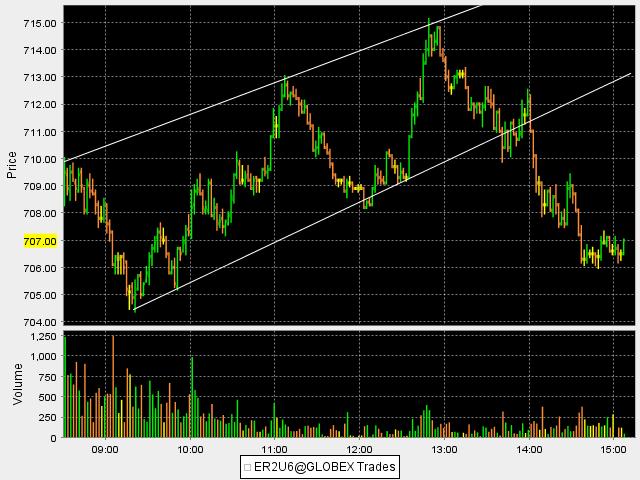
1. 705 is 1 month support, should in with confidence. 715 is yesterday's support, and become today's resistence.

2. Today's bounce from 708 to 715 is sharp, with small volumn, it's a short!


ER2 chart:

The Most Important Psychological Skill for Traders

by Brett Steenbarger

Link: Part One, Part Two

A holiday weekend is a good time to review trading journals, pick apart your results, and engage in self-assessment.

If your results are not what you hoped for, an important question to ask yourself is, "Why?".

There are three basic reasons why traders don't succeed:

1) They are trading a market and time frame that lacks opportunity;
2) They are trading a method that does not possess an objective edge in the marketplace;
3) They have a promising market, time frame, and method, but are not executing it properly.

Of these reasons, #3 is the most frustrating for traders. They feel as though they have the tools to succeed, but they themselves get in the way of their own success. Many times this is because emotional factors interfere with sound decision-making.

My recent post on techniques for dealing with emotional disruptions of trading offered a number of links to articles on cognitive, behavioral, and solution-focused methods for gaining self-control. Many more articles on trading psychology are available on my personal site, and a much more detailed explanation of the relationship between psychology and trading can be found in my book. It was because interest was so high in learning self-help methods for dealing with emotional disruptions of trading that I included step-by-step self-help manuals as the last two chapters of my latest book.

My hope is that these resources will help traders become their own mentors.

After my recent post, I received several emails asking a similar question: "What is the best technique I can use for getting myself in control?"

Most psychological disruptions of trading involve either under-control or over-control: traders either become impulsive and lose discipline when frustrated (resulting in overtrading), or they become anxious and negative (and miss out on opportunity).

The key to understanding these problems, as I stress in my book, is to recognize that they are generally state-dependent. They do not occur at all times, under all conditions. Rather, they are triggered by particular events and associated emotional states. The trader who is frustrated or depressed trades differently from the trader who is in a normal, non-aroused emotional state. This is because of brain physiology: we activate different brain regions and functions under conditions of arousal vs. conditions of calm concentration.

For this reason, the most important psychological skill for traders is simply the ability to control your body's level of arousal. It is near-impossible to maintain a collected frame of mind when your body is racing in flight-or-fight response patterns or withdrawing in the face of defeat. If you can control the body, you are much better positioned to achieve cognitive and emotional control.

Three steps can help you gain rapid control if you practice them frequently:

1) Stop whatever you are doing and take a break;

2) Sit comfortably and focus your attention on something neutral. As I mention in my book, a sound and light machine is ideal for this: you simply focus on the patterns of light and eliminate (as much as possible) stray thoughts. Biofeedback games can also be effective in focusing your attention;

3) Once you have your attention fixed, regulate your breathing by taking longer, deeper, and slower breaths. The slowing and deepening of the rate of your breathing will help slow your heart rate, lower your muscle tension, and reduce other biofeedback indicators of stress.

In the beginning, you may need to do this exercise for 10-15 minutes at a time a couple of times per day. As you become more skilled, you'll find that it takes less and less time to get yourself focused and calm. Eventually, just focusing your mind and taking a few deep breaths will get the job done. But it takes steady, consistent practice.

The exercise interrupts negative patterns of thought by controlling your concentration. It also slows your body down, which in turn helps you slow down racing thoughts. Because so many negative behavior patterns are triggered by states of frustration, heading off these states by proactively engaging in this exercise is especially effective.

Take a look at your P/L. How much money have you lost by not following your rules due to emotional disruption? If that figure is significant, the investment of time you spend learning these techniques will produce meaningful returns.

In my next post, we'll take a look at how you can integrate cognitive methods into the basic relaxation exercise.
My last post explained how psychological disruptions of trading are linked to state shifts that manifest themselves emotionally, cognitively, and physiologically. Very often these shifts involve states of heightened arousal due to frustration, fear, and anger. The previous post explained how these states can be defused by combining focused concentration with deepened, slowed breathing. With consistent practice, traders can become quite adept at calming their minds and bodies and interrupting processes that interfere with good decision making.

A related skill that I describe in The Psychology of Trading is "taking your emotional temperature." This simply means that you periodically stand outside yourself as an observer and notice your thoughts, feelings, and physical state. By making this self-observation a regular practice, you can become skilled at catching state shifts as they are occurring. This enables you to utilize the focusing and breathing exercises proactively, before emotional triggers can disrupt trading decisions.

Such a proactive use of the focus and breathing is especially effective when combined with cognitive techniques. Here's how to do it:

First off, I recommend that anyone trying these methods reduce their trading size significantly. By taking P/L off the table temporarily, it allows you to focus on developing your self-control. Then, with your success in the exercises, you can gradually build back to a normal trading size. (Note that if reducing your trading size by itself eliminates your emotional disruptions, that in itself may be your problem: you may be trading too large for your account size and your personal risk tolerance.)

Second, before adding cognitive components, it's necessary to truly master the focusing and breathing from the previous post. I generally have people practicing those methods at least twice a day for a full week before adding new components. The goal is to be able to calm yourself significantly with just a focused mind and a few deep, slow breaths. This takes consistent practice.

Once you can focus and relax yourself on demand, you're ready to add a cognitive module to your self-mentoring. Before you start trading, sit comfortably and vividly imagine market situations that would normally lead you to become fearful or frustrated. For example, you can "play a movie in your head" of the market moving against you and hitting your stop-loss point. The key is imagining the market action and your stop in vivid detail--while you are doing your deep, slow breathing. Then continue your "movie" by vividly imagining yourself taking the right course of action in that situation. Imagine how you would talk to yourself in that situation and what actions you'd take in the market--again, all the while keeping yourself calm and focused, breathing deeply and slowly.

You may need to repeat your "movies" several times with variations. In all, I recommend spending at least 15 minutes with this exercise prior to the market open. What you're doing is literally training yourself to stay calm and focused (and to do the right things) in situations that used to take you out of your game. By repeating these situations in your head many, many times, you normalize them (and your response to them) and make them familiar and non-threatening. Facing a situation again and again successfully in your mind prepares you to do the right things when those situations actually occur.

Notice that this method will work, not only for trading problems, but any situation that tends to trigger you and lead to unwanted reactions. Mental rehearsals under conditions of self control are a method for extending our free will, our ability to respond to events as we wish. This is not only helpful in trading, but in all of life.

Wednesday, September 06, 2006

9/6/2006 thoughts

Some thoughts on intraday trading: trend is No1, price not important. Need to focus on trend change signal : reach support, resistence, trendline continuation, trendline broken.


ER2 chart today


Actually yestoday there are lots of hints to market top:
  1. TNX up without reason.
  2. VIX shows bottom out.
  3. DOW, SP close to year high, big resistence ahead.
  4. ER2 big wave >30p already. This wave is from 693.x to 729, about 35p.
  5. DOW & SP show tired sign, no strength at all.

$TNX was up 0.5 yestoday for no reason. It was a myth to me. Today it's clear, bond traders knew the news in advance. $TNX up one day before the news out. The lesson here is to find the clue from 蛛丝马迹.

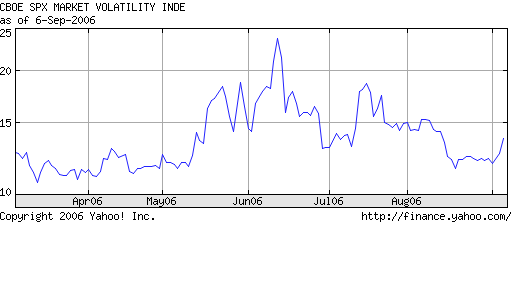
Also, ^VIX showed bottom out yestoday. And today it proved market topped. See the chart below:


All SP, NAZ, DOW charts show top sign as below.

NAZ 6-month chart:


DOW 6-month chart:

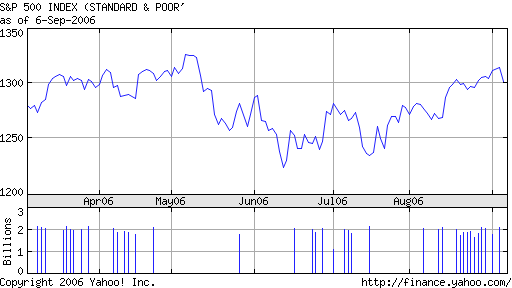
SP500 6-month chart:

Tuesday, September 05, 2006

看了这篇文,让你少走10年弯路(转载)

Link: http://bestrongarm.blog.hexun.com/4973432_d.html

宏观和微观确实在投机实践中是可以达到几乎完美的融合,而不再是哲学意义和高度上的融合。我认识的一个朋友(也可以说是我的老师),他在交易上的确已经接 近了“无招胜有招”的境界,这在我以前是无法想象的。因为我非常看重细节和微观上的技术套路,也即我们常提到的所谓“交易系统”。通过对他的交易决策的研 究,我发现,真正达到将所有技术(传统分析技术、指标公式、波浪江恩、时间周期、趋势跟随)融合为一体是完全可以作到的,只不过需要经历非常痛苦思考、提 炼、再思考、再提炼的循环过程,而我们大多数人,在这种冶炼的过程中,或者由于我们的悟性不够,或者由于我们的韧性不够,因此,99%的人是无法在投机市 场中实现自己的升华和嬗变的,这个过程,我认为,叫做“炼金术”好象还不够贴切,我更愿意将她喻为一种“化蝶”的过程,再痛苦艰难,但如果我们坚持将专业 投机作为我们的理想和职业,那么我们就必须完成这一可能是非常漫长的转变。

  我的一个领悟是,以后的时间,我将不再满足于对我的交 易系统的一些技术细节的完善和发掘,我必须用更多时间去完成,可能有些人甚至认为是“毫无意义或浪费时间”的思考历练。这种抽象的思考不再境界式或粗线条 式的,这种抽象是必须建立在诸多细枝末节之上的超乎归纳综合的一种质变式的提升。我不知道,我这样讲,大家能否能引起共鸣。我再次感觉到语言的乏力,但我 知道,我必须要影着头皮,超越存在于语言之中的玄虚,完成自己生命和事业上真正的突破。

  我对这种突破的艰难性、复杂性、不确定性 已经有了足够充分和清醒的认识,我也知道,我毕生都无法完成这种突破的可能性也完全存在。但我知道,我心灵所指的那个方向,才是超越投机、超越交易者、甚 至超越市场、并几乎接近生命之道的那个方向,不管能否抵达,至少,我必须调校好自己的方向,对准她,然后迈出我的步伐。

  人们常说一句话,在期货市场中,纪律和心态控制重于一切。然而,我却要不客气的指出,这一切的前提,是你必须要有一套完善、经过市场考验的交易系统,否则,就有流于空谈的危险。

   在我自己的实践中,我在最终设计并完善了自己的交易系统之后,心态自然更加稳定、自信,而你也必然用最严格的纪律去遵循你系统指示的信号行事,因为违反 他,将把你置于非常不利的境地。在你和你的交易系统充分磨合而且你确信你的交易系统可以成功、灵敏的应付大多数市场变化的时候,你会发现,通过交易赚钱, 其实是一件轻松、快乐、自然、水到渠成的事情。一切都变得和谐,你终将远离并告别亏损,这就是我切身的体验。

  其实,我的这些体 验,对于初入投机行业的朋友来说,没有任何用处,或者说,是一些空话。但是,我对于朋友们的忠告是,一定要建立适合你自己的交易系统,无论你被市场掴的鼻 青脸肿,你必须重新站起来,再改善你的系统。不要惧怕复杂和繁琐,因为,这是你迈向成功、脱离亏损的唯一之途,别无他法。纪律和心态必须建立在科学有效的 系统之上,当然,这种系统,他可以是基于技术分析的,也可以是基于基本分析的,或是其他如周易预测技术的。我始终认为,感觉是无法长期可靠的,只有客观的 系统,才能保证你有客观的心态。 

  我认识的一位香港的专业恒指期货做手,他在恒指市场已经生存了近十年。他讲到,当年和他一起做恒指 的,有的改行了,有的破产了,他所认识的和他一起进入这个市场的并且至今还生存于该市场的,只有他一个。时间的力量超乎我们想象的强大,看对一两年、盈利 一两年并不足为奇。只有经历长时间的洗涤、磨砺和淘汰,才可以看出你真正的投机才能。而他的基于自己设计的数学模型在计算机上建立的交易系统,直到今天, 他仍然在完善和修正。从他的身上,我看到了一个“专业交易者”身上的“专业性”所在。同他相比,我只不过是个篮球爱好者,而他已经是NBA中驰骋的职业运 动员了。我回来做在车上的时候才想到,时间的积分和微分作用,在我的身上,刚刚显现。

  其实,对于每一个职业交易者而言,心里都明白交易系统的重要性。我最近有一个想法,将自己用了5年多时间建立自己交易系统的体验,整理成文字,期望能对大家最终构建自己的系统有所启发。
  
  建立一个真正经历市场考验的成熟可用的一致性的系统,我认为,必定会历经两个阶段。

  1。堆积
   我说的所谓的堆积,大概等同于“厚积薄发”的“厚积”的过程吧。在这个积累阶段,是大量储备各种知识、技巧、方法的阶段,强调的是尽最大可能,广泛占 有,兼收并蓄,甚至要发扬“囫囵吞枣”、“不求甚解”、“神农氏遍尝百草”的杂家精神,把你能收集到的一切素材,积淀到你的大脑,以备后用。

   积累从何而来?当然首先是书籍。你必须要有横扫一切大小金融书店的气概,不需要有太强的针对性,但必须有广泛性,中西并举,阅读各类金融、经济类书籍。 有条件的最好请老手开一个书单,这样阅读起来更有针对性,效率也更高。这大概就类似于古人所说的“熟读唐诗三百首”吧。我的经验是,以西方经典的技术分析 文丛开始下手,先开立一个20本左右的书单,英文水平高的最好直接阅读原版,用最简单的串行方式,将其一本本消灭。这整个过程完全没有任何投机取巧,过程 虽然枯燥冗长,却不可替代、不可跨越。而且,对于好书,要一遍又一遍的读,直到烂熟于胸为止。

  堆积的过程更多使用的智能,是记忆 和少量的推理。你首要的是,牢记书里的方法和教条,并不需要你有太多的怀疑主义和主观能动。因为这两者是必须在你有一定积累的基础上才会涉及。你如果可以 在国外任何一项标准智商测试中,轻松取得最前面两个级别的评分的话,我想,这个阶段对于你,可能只需要2-3年的时间,间中你还有余暇阅读些哲学、方法论 类似的书籍,起到旁征博引、互相贯通的意义。

  在阅读阶段,也不是我妄自菲薄,我认为应尽量少读国内的读物,而尽一切可能(如去国 外网站订购等)去不知疲倦的阅读西方的经典文丛,尤其是技术分析方面的。其实,老手的书房中的书单,对于新手来说,就是最大的财富了,可以少让你走许多的 弯路。我本人就是在几乎扫遍了国内几乎所有的跟庄、投机书籍之后,才绕了个大弯,在朋友的指点下,开始阅读西方的技术分析经典,也读过少量几本原版的“圣 经”“儒家”类书籍。

  积累的素材除了来自于书籍之外,当然还有网络。你应该有横扫国内外大多数最著名的论坛的决心,以谦虚、容纳 的胸怀去阅读一切坛子里老手的文章和体会。个人的体会有时候比书籍来的更为直接、更为深刻。我个人来讲,在其他论坛结识的一些好手,对我的帮助作用,可以 说是极其深远的。

  除了这两者之外,我认为,你应该把所有(记住,是所有)的时间用于看盘,读盘,复盘!!!

  看盘,其实对于刚开始的时候来说,无非就是个“外行看热闹”的罢了,但这个热闹,无论如何,你硬着头皮,也得看下去。

   有条件的,看一切你能看到历史数据的市场行情:外汇、商品、利率、期指、股票等。尤其是指数,观察、分析、预测各个市场指数现货和期货的走势,至少要占 到你所有看盘时间的70%左右。即使在股票市场,我的理念是,指数终于一切,永远看着指数的脸色行事,绝对不做类似股评的所谓“抛开大盘做个股”的傻事。 我不认为,自己总可以骁幸抓到跑赢大盘或独立于大盘走势的个股。

  而且,看盘的过程,也是很好的总结、运用你阅读的知识的一个场合和机会。

我在看盘、盯盘的过程中,经历了这样几个阶段:

  一、看热闹阶段
  天天盯着涨幅榜第一板的看,眼睛里只看到涨、跌的曲线,心里没有任何感觉。

  二、初级阶段
  买了书,知道了比如量比等技术指标,知道了综合排序,知道了分钟排行,知道了资金流向,知道了热点板块和集团式热点,看的时候稍微有了目的性和筛选性。就像上网冲浪一样,知道用搜索引擎来过滤出自己需要的信息了。

  三、进阶
   目的性更加明确,有了分门别类的自选项目、板块,从十几只品种的走势能大致判断大盘的运行趋向,学会了公式选股,自创指标,测试交易公式(还谈不上交易 系统)等进阶技术,开始排斥传统技术和指标,自以为进入了交易的核心,醉心于编写公式和所谓的“交易系统”,并利用自己设计的指标来衡量指数和股票。

  四、系统化
   对几乎所有具备历史数据的市场进行长时间的盯、复盘,尤其是美指、曰经和恒指。(这三只是我最喜爱的品种)不过,盯外盘的代价也是巨大的,所有与我年龄 不相称的疾病接踵而至,呵呵。我在长时间坚持跨市场的研究中,终于构建出自己的交易系统。彻底屏弃所有写指标、公式(除了我系统中需要用到的)的玩意儿 (现在看起来,那些依靠高、开、低、收、量所运算得来的“秘密公式或系统”都是些可笑而不置一提的东西),回归到了最简单、原始的几项技术(说出来,这些 技术我敢说刚进入市场的人可能都听说过)。看盘的目的是为了验证系统,完善系统。

  五、整合阶段
  你终于发现,在有效 的交易系统的指导下,你可以迅速熟悉陌生的市场并成为该市场的专家,正是应验了那句话,“股价运动包含一切信息”。你能想象,我几乎完全不懂也完全不关心 天然胶、大豆、铜等基本面方面的供求分析技术的前提下,却在并不完善的国内商品市场上同样没有障碍的获利。我刚进市场那时候,不怕你们笑话,我甚至不知道 中国是世界上最大用胶大国,而最大产胶国是泰国、印尼等东南亚国家。我在只做了一周模拟交易之后,就用自己的保证金开始了交易。我不懂基本分析,我也瞧不 起那些并不专业的伪基本分析者。我只知道,有效的系统和心理控制力,就可以保证我,在任何市场获利,就这么简单。

  上面我提到的第四个阶段,是非常关键的。是你能否最终拥有适合自己交易系统的关键。

   这个阶段,他可能只是些又费时、又费力、而且暂时还看不到任何效果的简单工作。甚至有时候,你自己都会怀疑自己是否在做无谓、无意义的努力。但我要说, 这个阶段是不可逾越的,你只有盯盘盯到“为伊消得人憔悴、衣带渐宽终不悔”的程度,你才有可能进到“蓦然回首,那人却在灯火阑珊处”的境界。不要顾及别人 的怀疑或耻笑,要坚定自己的信念。你既然选择了职业投机,那么这个阶段就是你义无返顾的选择,别无他途。你要设法在曲线的运用中,综合你所有知道的交易技 术知识,去解释已有的和预测还未发生的。

  我不敢保证,人人都能走出这个阶段。我发现,投机这个行业,是为数不多的你即使付出心 血、辛劳和汗水,却未必能登顶成功的几个行业之一。这个完全需要概率化、容忍失败和不完美的行业,注定最终成功的,只能是那些同时拥有勤奋、天赋和机遇的 少数幸运儿。所以,选择职业交易者是必须要经过极其慎重选择的,因为,有的时候,回报并不理所当然的与你的付出成正比。除非你从心里热爱投机,甚至乐于接 受一事无成的最终结果,否则,我真的劝你,请慎重你的选择。

  我想用海特的一句话,和大家共勉:
  首先,你要有一套有效的价格预测系统,更重要的是良好的资金管理和风险控制机制.用“分散”而“持久”的眼光对待交易,在投机市场上长期地占有概率优势,而不是孤注一掷.这就是金融交易的全部.

  2.嬗变
  如果说前面的堆积阶段只是个简单、线性的累积知识的话,那么这个阶段,你就必须利用你智能中的诸如推理、综合、归纳、联想、顿悟等对第一阶段所积累的素材,做集中的消化和吸收了,直至这些杂乱无章的知识被你咀嚼为一种灵性的东西,并浸润你思维的血液。

   你必须最大限度的发挥你的怀疑主义,怀疑一切你所读、所看的东西,用你的思维去重新诠释,而不论这种诠释在别人看来,是极其幼稚可笑甚至是荒谬的。我认 为这是学习的关键,总之你必须迈出你思维独立的脚步,彻底摆脱“人云亦云”的境地。别人的高明终归是别人的,你必须经过思考,获得属于你自己的高明。创造 和学习永远是相辅相成的,互为基础。学习别人的经验和知识只是手段,如果学习反而让你丧失自己的创造、创新能力的话,那就背离了学习的初衷。学习,只不过 是为你后续的创造提供素材和养料而已,而变成你自己的血液这个过程,则需要创造来提升。

  学习是线性的,而创造则属于非线性。正是后者,给世界带来了多姿多采。

  简而言之,就是融会贯通,提炼、萃取出自己的系统交易方法。
   我有一个体会,语言是帮助你整理头绪、理清思路的很好借助。升华的过程不可能一蹴而就,你在这期间依然要籍借一些琐碎的方法,比如,坚持写交易曰记,做 详尽的案例分析等。我想,很难用具体的文字去描述“嬗变”这个阶段,我只能大致的说,你必须活动开你思维的肌肉,不拘一格,运用你灵活有力、充满灵性的神 经系统,去不断的接近你所探求的东西———市场的本质。

  判断市场的趋势,是至关重要的。
  说实话,为了成为真正职业 的交易者,我几乎丧失了所有的兴趣爱好,过着孤独、清淡甚至有些枯燥生活。不过,时间让我逐渐乐在其中,而无须去忍受。有时候,我也怀疑过,这样的生活是 否值得,又是否必要。但是,所谓的得失其实全是相对的,况且,在交易中,我确实获得了除了盈利之外的乐趣,难以言表的乐趣。

  交易 实践让我丧失了太多的冲动和激情,原来需要忍受的东西,渐渐的变得享受并沉醉其中,甚至会让人滋生出些须自恋的倾向。周末时刻,便是将监禁并遭受各种控制 的心情,放出来放风的时候。我逐渐适应了容忍自己甚至两天不看专业书籍或图表,而听任自己找个地方,去爬爬山,或听听音乐,即使思考,也让他远离交易和市 场。我知道,我如果要将交易作为我终生的乐趣和事业,我必须训练自己的心情,可以随时在市场和生活中快速的切换角色。毕竟,专业的交易者,他首先是个具备 丰富内心世界和涵养的人。

  我周围几乎所有的朋友,都说我的生活,极其枯燥而缺乏色彩,少了那么多的人生乐趣。当然,也有极少数朋友,过者比我更深居简出的生活。电脑行情中的曲线,几乎成为了他们人生的轨迹。我总想折中,可我深知这种折中,以我目前的阅历和智慧,还远远不够。

  市场的本质是交换,其实,生命中,何尝又不是充满了得与失的交易?我选择了一般人无法忍受的“枯燥”的生活,可我交换得来了更强大的自信心和比别人更能有力的思考能力、洞察能力。而且,交易的成功直接换来的是获得了“享有未来美好生活的期权”!

  所以,我想鼓励我们从未谋面的但有着相同理想的年轻人,为了获得这份期权合约,我们共同努力!


  最近重新读尼可。李森的自传,感受极深。

  李森交易的失败,在我看来,有两个最主要的原因:

   1。逆市场中级趋势而为,认为自己可以干预和战胜市场。我甚至都能体会到李森在SIMEX中孤独绝望的孤注一掷的赌徒心态。他在试图平仓自己多头头寸的 时候,经常会不小心发现自己又累积了500份多头。最后,整个市场只有他一个人在买,在看多,而他周围的经纪人全成了他的交易对手。当他在1995年2月 积累了6万多张曰经多头(折合约100亿美金),他已经完全丧失交易员必须的冷静和客观,他不再有能力观察市场,却经常以为可以操控市场。事实上,他确实 经常可以令市场反弹个100-200点,而且,一旦失去了他的买盘,市场就显现出羸弱的疲态。道氏很早就极其正确的指出,长期趋势(PRIMARY TREND)是无法被操纵的。而李森,最明显的,违反了这个常识性的认识。而他,在当时,被认为是世界上少数理解期权、期货市场运做原理的人。

   2。交易时机的失误。事实上,曰经指数在李森做多的时候,也确实处于某级别下跌趋势末期。但是,市场在很多时候,都证明空头(或多头)在最后抵抗的时候 也是非常凶猛的。高明的交易者总是等待一方力量竭尽枯竭的时候,收获渔翁之利,给顽抗者最后一击。在一方力量仍然未到强弩之末的时候,贸然迎击并非明智之 举。我们必须要尽量躲避市场最后的反扑,努力使自己不要被消灭在黎明前的黑暗。李森的多头成本大约位于18000附近。事实上,他在1995年2月底被新 加坡警方抓获,而曰经指数于1995年6月底7月初的时候,探至14000左右的低点,并在其后一年的时间里展开了强力的单边反弹,最高反弹至22750 的位置。当然,可怜的李森已经在监狱中服刑了,而他所巴林银行,也等不到艳阳高照的这个时刻了。

  总之,在明显的下跌市道中(下跌 接近收尾阶段),逆市场趋势而为,试图阻止市场下跌趋势的发展、发育、完成,并超出能力的加下如输红眼的赌徒一般的没有后路(没有止损及相应保护措施。事 实上,李森在对冲的品种JGB中,同样看反)的死码,是李森及巴林银行最终牺牲在革命战争取得胜利的前夕的最终原因。

  其实,解决 你问题的最根本办法,就是建立自己的交易系统。建议你读一下波涛的三步曲,重点读一下 《系统交易方法》。不过,我本人对这套书的看法,并非向业内其他人一样,给予那么高的评价。其实,他确实没有提供一点具体的系统规则或设计思路上的东西, 他更多的给出的是一种哲学上的思考,以及如何测试及维护一套交易系统。书中虽然给出了建立交易系统的大致框架性的步骤,但你要试图找出一些具体的线索,那 绝对是徒劳,因为,毕竟那是真正的商业秘密。天下没有免费的午餐呐。

  不过,我觉得,这套书,在你构件自己的交易系统时,确实可以提供宏观思路方面上的指导。

   其实,史蒂夫。尼森的《曰本蜡烛图技术》是我的案头必备,也是我最爱读的书籍之一。而且,在我的交易系统中,蜡烛图技术是占有相当权重的,我把他当做重 要的验证信号之一。我认为,这门古老的东方投资艺术,如果可以和西方的技术分析手段互为验证,将发挥更大的作用。事实上,这本书的作者本人也非常强调融会 贯通。毕竟,各类技术都有他相应最擅长的场合和成功率,互为验证,取长补短,是适当使用技术分析的关键。

  我的承受大风险杠杆的资金头 寸无论如何也不会超过10%的。而且,在这10%的风险头寸中,我会将其细化为三级,即在高风险档中,再细分为低中高三档,以期更合理化的规划、分布和控 制整个风险头寸中的风险度。不过,和大多数国外对冲基金经理的做法不一样的是,我从不对冲风险,也不做套利。在真正的市场机会下,我在设计好退出计划的基 础上,我操作的多类衍生产品,全部是同方向的!比如,我甚至会设计成用期指来保障我的CALL OPTION的PREMIUM。呵呵,我想,国外同行恐怕很难理解并赞同我这种怪异的做法。其实,说穿了,真正核心的,就是你有没有NB的交易系统,可以 分解并理解目前的市场趋势,这才是核心所在。至于那些用期权、期指来设计的各种套利策略组合,在我看来,如果你拥有了有效的交易系统,这些手段全部不值得 一提。我所要做的,不是去锁定风险,而是在同一个方向,放大放大再放大!

  文字总结了自己在建立交易系统过程中的一些体会、经验以 及心路历程和几个必经阶段,祁望能对志同道合者有些许启发和共鸣。至于具体的技术细节和实现过程,我想这是每一个职业投机者所必须经历的,最终只能由你自 己长时间的坚持、积累、总结、归纳再加上一点点的机缘,才有可能达到目标。你如果选择投机为自己的终身职业,就不要幻想可以获得不须努力的现成结果。换句 话说,没有辛勤的努力和汗水,就算得到了优秀的系统,也不可能发挥他的真正功力,因为系统正确使用的前提,是需要使用者各方面的深厚积淀和素养的堆积的。 所以,我只能对您的要求说抱歉了。

  其实预测系统只是交易系统中很小的一部分。而且,盈利的大小和预测对错也并非总是成正比。我有时也 犯看对了没赚够的错误,顺势才是关键。我有个朋友,他几乎从来就不预测,只跟随趋势,永远在右侧交易,而我几年的平均赢利率目前还不如他,这就证明了,没 有神奇的预测,一样可以成为大赢家。

volumn watch

We may pay attention to the volumn during up wave and down wave and estimate the open long positions.

Most future positions will be closed before close, thus can get some feeling on the sell off or short squeeze in the last minutes.

ER2 Sep 05, 2006 chart:

Saturday, September 02, 2006

交易方案的制定及执行 (转载)

link: http://www.trader168.com/bbs/viewtopic.php?f=18&t=390&hilit=

by
  • 进场条件
  • 进场的误区,就是被假象蒙了,是自己的什么心理导致容易中套?
  • 盈利时如何出场,中间的处理过程
  • 亏损时如何处理,是需要紧密止损,还是大止损,在止损达到前AD,有无其他处理办法,比如用其他股票锁定?如锁定不住该如何处理?用作锁定的股票如何处理?设定多大的止损?盈利如何出局, --亏损的唯一可能,极端重要!!!!
  • 为何能赚,即能赚的原理,赚的是谁的,优势是什么,靠什么盈利,心理对抗考验的是什么
  • 成功概率多少
  • 下单进场时需要什么心理,过程中需要什么心理,每下单前必须告诉自己,这次考验的是我的什么素质
  • 如何调节心理到需要的状态--具体步骤,怎样保证这个步骤的顺利完成
  • 每次出手的考核是否达到真正trader的标准,包括机会出现时的敢不敢作为
  • 每笔完成后的奖惩.记录

Thursday, August 31, 2006

但愿你飞^o^-nasdaq股市笔记

但愿你飞^o^-nasdaq股市笔记

8/31 Lesson - one importan pattern about chasing stocks

Look at 3 stocks: AAPL MCRS JOYG
All of them fall into following pattern:

1. Near year low. Current year, may not 52 week low. But anyway not far from 52 week low.
2. Report ER.
3. Was strong stock before.
4. Gap up at open (or AH).
5. Broard market not very bad.

The action should taken is: chase at open next morning.

As example, JOYG is close to 2006 low, when broard market bounce quite some it's not. Reported good ER in AH yestoday, gap up at open today at 39. It's a chase. It closed at 43.54 and I expect it going higher in the following days. The Sep 40 call was 1.2 at open, high is 4.5. 400% return in one day.

ER2 chart for 8/31/2006:


Wednesday, August 30, 2006

08/30 --3 months data

From June to end of Aug
YM: 11300 -> 10800 -> 11300 -> 10800 -> 11400
ES : 1300 -> 1240 -> 1287 -> 1240 -> 1307
NQ : 1600 -> 1530 -> 1600 -> 1450 -> 1587
Er2 : 740 -> 680 -> 735 -> 675 -> 723

08/30

1. Overall feeling is still too many shorts, Put/Call =1.03

2. most time ER2's range is from 719.5 to 723.5. However both ES and YM lost steam today and unable to create new highs. Part of the reason could be energy is lower. Technology is gainging momentum. However JDSU warned may cool it a bit.

3. Need pay more attention to gap up/down.

Leading Sectors: Disk Drives +2.14% Semis +1.80% Networking +1.36%
Lagging Sectors: Energy -1.62% Oil Service -2.12% Oil Tankers -2.17%

ER2 chart today:

Tuesday, August 29, 2006

08/29 Lessons

1. SAFM gap up: good ER, high short ratio(31%), open 28, up to 30.3

2. Always watch chart : at 704.5 down trend broken, it's a long there.

3. Pay attention to spike: spike means MM action. Usually pattern is spike up--->consolidation--->another spike. Best time is to in at consolidation area.

4. Don't enlarge a pos after a lose trade

5. Market usually to follows the trend from 12PM to 1PM.

6. # get some info that lot ppl intend to short(4:1) means retailer are over bearish, MM can use it to squzzz.

7. 716.x is last time high, ER2 was pushed to that level to force shorts to cover.

闲聊money management (转载)

Link: http://sizzlingstock.com/forum/viewtopic.php?t=691&postdays=0&postorder=asc&start=0
Link: http://en.wikipedia.org/wiki/Kelly_criterion

By NYTT

因为我是做emini的,所以跟做股票的情况略有不同.做股票的有diversify的问题. 我现在来谈谈其他方面的问题.就当消磨时间.

如果你去赌场,你怎么运用money management?

这个问题的答案是:money management 没有意义.因为你有一个unfavorable odds,不管你怎么分配你的资金,你能改变的是你输钱的时间是长还是短.所以money management的第一个要点是:get a favorable odds.

只有这一点确定了,才有赢的可能性.才能谈运用其他money management.你要清楚的认识自己的trading skill 到什么程度,能不能拿到favorable odds.那么如果你拿不到怎么办?从money management的观点,你就不应该投入资金.你应该只做模拟,直到你的trading 达到那个水平.如果你觉得不投入资金,水平没法提高,那么你要明确你投入的资金是学费,不是赌资.这些钱是让你学习怎样提高水平去拿到那个 favorable odds,不是让你在unfavorable odds情况下赌一把.所以要安排好你的资金,使之能支持到你毕业.

第二点,如果你的trading skill达到favorable odds的程度,运用money management就比较简单了.这和打扑克有点类似.一个好的扑克牌手的money management就是两件事: 1)安排好自己总赌资和每一次赌注之间的关系,使自己的总赌资能survive the worst scenario;2)根据每一把的不同odds,改变自己下注的分量. 一个好trader必然会对各种情况下的odds有客观的估计,并根据每个trade情况决定使用的资金量,odds 大的使用的多,odds不够大的,使用的少或干脆不做.同时保证在worst scenario下不被wipe out. money management的一个非常重要的方面,是不被自己的情绪左右,改变自己已确定的discipline.一个经常出现,并最危险的case,是在输了 以后,为了减轻自己psychology pain,加大赌注,想扳回损失.这时候因为头脑发热,根本等不及一个favorable odds,上的资金量也是unreasonably high.最后完全变成一场赌博,而且往往是在unfavorable odds情况下. 所以如何保持自己的自我控制力,冷静,客观地使用资金,是money management的一个非常重要的方面. 当你进入一个position,价钱向另一方向走,这时候有两个改变:1)有比你原来更好的价钱;2)趋势变的unfavorable,或者说你的 odds向unfavorable方向变.这时候新手往往会AD,这种作法跟输了加大赌注想扳回来,本质上是一样的,就是在unfavorable的情况 下加注.价钱和趋势相比,永远是趋势更重要,要让趋势决定你的操作,不要让价钱决定你的操作.你AD的后果,不但是在unfavorable的情况加注, 而且在心理上让你更不愿意stop loss.

第三点是用好stop loss. trading和扑克的主要不同,在于对于扑克,你下了注就不能拿回来,除非你赢了. 而trading你看到情况不对,你可以cut.这一点决定了trading的技术成分比扑克大的多.stop loss作用不光是保护你的资金,也能够提高你的profit.stop loss的点设在哪里,很值得花大力气去研究.并不是简单地设一个比率.设的不好,本来该赢的trade也给stop掉了.要尽可能提高正确率.就是说你 的stop hit 以后,他要真的跌下去,他不跌的,就hit不到你的stop.你的stop loss的点设对了,你就会有安全感,就敢上大量,从而提高你的return.


comments by 史前游客
DAVE你问这样的问题, 足以证明你没有看过KELLY CRITERION. 其实这个公式很简洁, P=E. 你每次押的PERCENTAGE等于你的EDGE. (怎么计算EDGE, 自己全看吧) 押100%是什么概念? 只有在EDGE=100的时候才可以. 比如完全RISK-FREE的ARBITRAGE.

多数人的问题是没有EDGE. 少数人的问题是有了EDGE, 却OVER-LEVERAGE. 事实上如果用P=2E, 你的EV是0. 很多人犯的毛病是把自己的EDGE错误地算大. 倒不是有意OVER-LEVERAGE.

如果PLAY CONSERVATIVE, 每次P=0.5E, 也可以取得很好的成绩. 大约是OPTIMAL的60-70%. 但是VOLATIVITY就小了狠多.

Monday, August 28, 2006

Five ways to stop you breaking trading rules

Link:
http://globalgrowthinvestor.com/117/five-ways-to-stop-you-from-breaking-trading-rules/


Five ways to stop you breaking trading rules

One comment

Ugly at uglychart.com is struggling with sticking to his trading rules and has set up a support group. Here are five ways I stick to my system and keep myself on track.

These methods are based on the fact that successful trading is probably unnatural for us emotional and greedy human beings. So we have to put in structures and methods to counter our natural instincts.

1. Checklists

Filling out a simple checklist manually before you place a trade is effective because it says: STOP, is this rational or irrational?

A checklist might be as simple as:
a) Trade in direction of major trend? Yes/No
b) Trade in direction of general market trend? Yes/No
c) Risking 2% of capital? Yes/No
d) Risk/Reward ratio is 1:3? Yes/No

The more specific the checklist the better, and obviously it should capture the essence of your edge and be as simple as possible.

I put every trade I make through a checklist of fundamental, technical and market criteria. It’s not fool-proof but it does make me stop and think, and look at opportunities more rationally.

2. Know your edge

Sticking to your rules can be tough if deep down you don’t trust in your system. Or even worse, you think there’s something better out there! I suspect this happens a lot with traders who use other people’s methods and don’t modify them to suit themselves.

My system dictates that trades are placed with the goal of holding until the trend ends. That could be anything from a few days to a few months, or even more than a year. This is the best system for my personality, lifestyle and the objective of building up my capital.

But for a long time I thought that I should be ‘swing trading’: taking a lot of short-term trades to nail all these opportunities saw. Unfortunately, I would only swing trade when my account had big gains - feeling confident, I would try and squeeze out some more profits with a few short-term trades. Invariably this would mark the end of the market’s upswing. So my normal healthy drawdown was made worse by losses on swing trades.

To curb this habit of trying for some quick and easy profits, I now keep meticulous records of my trades, including Excel spreadsheets and a paste book of charts of every trade I make. By reviewing these records I have ingrained in myself that I only make money by sticking to my system.

3. Keep money in perspective

I’ve found I break rules when I am subconsciously thinking that I badly need money for something. For example, if you have a wedding coming up (as I do) that requires a big outlay of cash, subconsciously you’re thinking ‘I need to nail some big trades to pay for it.’ In that scenario you’re more likely to be trying to push trades that you normally wouldn’t have considered.

I assume this is exacerbated if you need to make a living from trading. Every trade is linked to paying your bills which is an enormous pressure to bear.

The key is to closely monitor your financial position and be aware of pressures that you may be under. Keeping a journal, or speaking frankly to your partner or a friend can help you deal with this.

4. Tell someone

One of the ways I tried to overcome my ‘swing trading’ issue was by making a rule that I had confess to my girlfriend (now fiancée) every time I had an urge to make a trade that didn’t fit my system.

On one occasion I can recall having an internal battle about whether to tell her or not. I could literally see the profits in my pocket from a potential swing trade. ‘I’ll be in and out and no one will ever know’ I thought. In the end I confessed and let the trade pass. As it turned out it wasn’t an opportunity and it would have left a serious dent in my account.
5. Don’t be too hard on yourself

We’re all human and we all make mistakes. If you read good trading blogs and research successful investors, their experiences are a litany of missed opportunities and mistakes. The common factor is persistence, and once they become successful they do everything they can not to blow up. But perfection is an unattainable goal.

08/28 some thoughts

1. oil down 2.6%, CRB down 1.95%, decreased ppl's concern about future inflation
2. no economy news today, usually this kind day is a up day!
3. SP is only 2.8% from year high, expect some resistence from here
4. stratege: short extrem

Before entering a pos, fill in the check list
A checklist might be as simple as:
a) Trade in direction of major trend? Yes/No
b) Trade in direction of general market trend? Yes/No
c) Risking 2% of capital? Yes/No
d) Risk/Reward ratio is 1:3? Yes/No